Wirtschaftswunder: The Story Behind Germany’s Economic Miracle
Was it really a miracle?
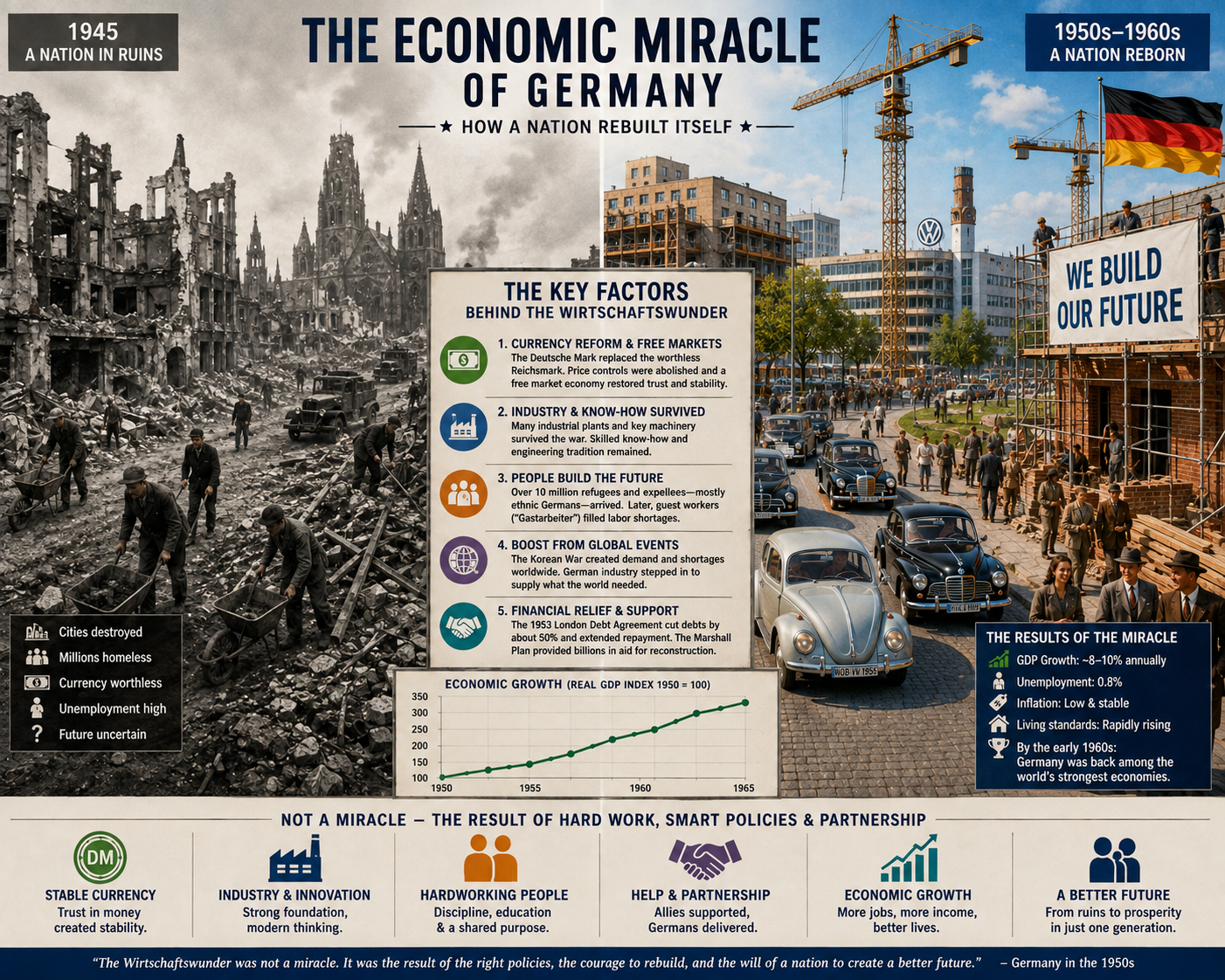
1 week ago I wrote an Einbürgerung test in Germany. It is a naturalization test consisting of 310 questions about basic laws, history, and how things work in Germany. One of the questions we had there was about the 50s Wirtschaftswunder that happened in Germany. Basically, what happened to Germany in the 50s and the way they transformed economically is called a miracle.
We don’t have to go into details. I think most people know that after the 2nd World War, a lot of German cities were demolished. Basically, a lot of things had to be rebuilt from zero.
Unfortunately, it was not that easy. A lot of people from Germany died as soldiers, millions of people were held captive in different countries, and keep in mind these were mostly men, many of them very young, full of power and energy, who were supposed to physically rebuild the country.
Despite this deficit, in the 50s Germany pulled this Wirtschaftswunder (literally: “economic miracle”) off.
Btw, when we talk about this economic miracle, mostly it is considered West Germany. The Soviets tried to recover the East German economy. They somewhat did it, but it definitely was not a miracle-like recovery.
Key Drivers Behind the Reconstruction ⚙️
Let me kind of break down why it happened and how Germans rebuilt the country.
-
- Currency Reform & Free Markets: Probably the biggest contributor to this miracle was currency reform. Overnight, Germany replaced the completely worthless Reichsmark, came up with the new currency Deutsche Mark, and abolished all the price and market control mechanisms that the Nazis had established. It became a functioning market economy. Money started to gain purchasing power again.
-
- Surviving Industrial Base & Know-How: Even though we have seen those images of destroyed German cities almost to the ground, a lot of it was in metropolitan city areas. A lot of heavy industrial areas somehow survived. For example, the Volkswagen plant in Wolfsburg, the BASF plant, and the BMW plant. Those plants were targeted, also bombed, but in most cases key machinery, piping, and manufacturing lines survived. At the same time Germany did not really struggle with human capital, neither pre-war nor post-war. The know-how survived.
-
- Inflow of Skilled Workers: Massive inflow of skilled refugee workers. We are talking about over 10 million people. Most people were ethnic German refugees and expellees. Later on when the economy started to boom a lot of people came as Gastarbeiter from countries like Italy, Turkey, etc. The shortage of labour was fixed pretty fast.
-
- Demand Driven by External Conflicts: It’s ironic, but Germany benefited from other wars. Even though Germany was not allowed to have an army until 1955, they benefited from the Korean War. The Korean War created shortages in steel, heavy machinery, and manufacturing goods. Germany stepped in to fill this gap.
-
- Financial Relief & International Aid: The 1953 London Debt Agreement substantially restructured West Germany’s pre- and post-war external public and commercial debts, reducing total face value and interest obligations by roughly 50% while extending repayment over decades. Also, according to the Marshall Plan, Germany received a couple billion worth of financial aid to rebuild its infrastructure.
Why Was It Called a Miracle? 📊
In that time span, the country experienced almost double-digit nominal GDP growth over 10 years, unemployment dropped to 0.8%, and inflation rates were very well controlled and low. By the beginning of the 1960s, Germany returned to the top-tier list of one of the strongest economies in the world.
Was It Really a Miracle? 🤔
I think it was not. They already had so much know-how, strong educational institutions, and the West did not step on Germany’s throat to squeeze out every penny for the damages the Nazi regime caused. So basically, there was nothing unexpected that happened.