Why Our Electricity Grids Are Becoming a Massive Problem
Data Centers make our grid problem even worse
I have basically never worked outside the energy industry. I am approaching my fourth year of corporate life, which I still can’t wrap my head around. Where does the time fly? Out of those four years, I spent four months working at a financial auditing firm as an auditor, but besides that, I have always worked in energy, specifically renewables.
I started off at Siemens Gamesa in procurement, more specifically in credit risk. Siemens Gamesa is one of the largest offshore wind turbine manufacturers in Europe, probably in the world as well. I used to calculate credit ratings for the suppliers Siemens worked with.
Then I got a job at Vattenfall, which is one of the largest electricity producers in Europe. Within Vattenfall, I work in the renewables department, where we build onshore and offshore wind parks, and Solar & Battery parks.
I never actually planned to work in the energy industry, but it naturally happened, and I liked it, so I decided to stay.
Throughout the years, I have already collected a pretty good amount of industry knowledge. Even though I am not an engineer, I also have collected some overall engineering knowledge as well, especially about how things operate.
Most people have no idea what’s going on in the energy industry if they don’t work there. But there are some common pain points that we, as energy companies, all share and struggle with. So I thought I could introduce you guys to some of them, so you can familiarize yourselves with the energy sector as well.
One of the Biggest Problems in Energy: Grid Congestion
One of the biggest pain points that countries around the world really struggle with in energy is congested electricity grids.
No matter how big the country is, whether you take the USA, countries in Europe, or China, all major economies have issues with congested grids.
Let’s first explain what the grid is and why it gets congested, and later, how we can potentially tackle this issue.
First of All, What Is the Grid?
Let’s take Vattenfall as an example.
Vattenfall is currently building Germany’s largest offshore wind farm project in the North Sea, called Nordlicht. The project consists of two wind farms, Nordlicht I and Nordlicht II, with a total of 112 wind turbines, each rated at 15 megawatts.
The company took the decision to buy these turbines, install them in the North Sea, generate electricity, and sell it to customers.
But this is not that simple.
The turbines are pretty far from residents. Actually, they are located around 85 km north of the island of Borkum.
It’s not like a turbine spins and voilà, you have electricity right away in your home.
So what actually happens?
The turbine starts to spin. Let’s say it spins 10 times per minute. That rotation needs to be converted into electricity.
Go ahead, you can try to spin something yourself 10 times a minute. You probably won’t see any electricity generated. To turn the mechanical energy into electricity you need a gearbox and generator.
So, just like on a bicycle, when a large gear drives a smaller gear, the smaller gear can spin faster. The gearbox inside the wind turbine increases the rotational speed before it reaches the generator.
Not to get into too much engineering detail, the generator then uses magnetic fields to convert that mechanical energy into electricity.
Now we have electricity, but we have another problem.
We don’t need electricity in the middle of the North Sea. We need it onshore, in our homes, factories, offices, and so on.
So the electricity from the turbines is collected through underwater cables and sent to offshore substations, where the voltage is stepped up and the electricity is prepared for long-distance transmission.
Then we transport it to shore through submarine cables.
Once the electricity reaches the mainland, it enters the wider electricity network. Through additional substations and transformers, the voltage is gradually stepped down before electricity is distributed to residential buildings.
Because obviously, you cannot send electricity at the same voltage used for long-distance transmission directly into your home. Your devices would basically start to explode.
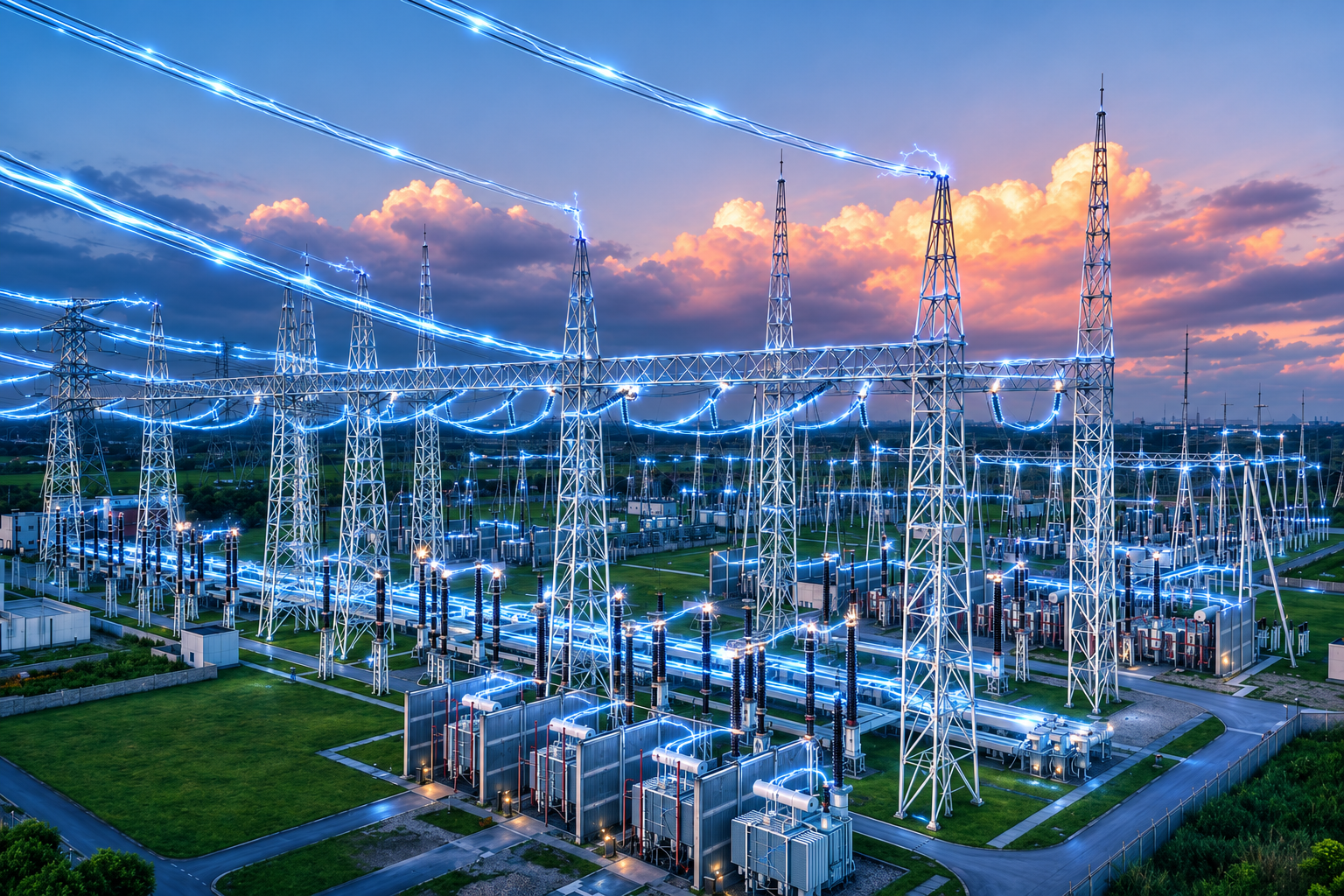
When we talk about the grid, we usually mean the substations, power lines, transformers, and basically the whole transmission and distribution network that moves electricity from producers to consumers.
Now imagine, I just told you about one single Vattenfall project in the North Sea. Vattenfall is not alone there are dozens of projects of similar magnitude doing the same thing and trying to connect to the electricity network.
Grid networks have their maximum capacity. One transformer can handle only so much electricity, and one cable can transport only so much without creating hazardous situations.
What makes the whole situation even worse are data centers.
Data centers require a steady, high input of electricity. It’s not like a home, where you turn off your devices at night or limit consumption while you’re at work.
No, these are demanding operations that need electricity 24/7.
And now they are like, “Oh, by the way, we also need grid capacity.” Literally everybody needs grid. I need grid, you need grid, your office needs grid, your facebook accounts need grid. Grid is currently the hottest commodity
But now you’re reading this, and your first thought probably is: “Okay Niko, then let’s expand our grid. Build more substations, more power lines, and more transformers.”
Very logical conclusion.
But it’s not that simple.
Why Can’t We Just Build More Grid Capacity?
1. The Grid Is One Big Connected System
The grid is one big connected system.
You generate electricity and transport it through the lines, but other than that, you have very limited control over where the electricity physically goes.
For example, Vattenfall can’t decide which home gets the exact electricity it generates.
Vattenfall can’t say, “The electricity I generate must end up in Niko’s home.”
Once electricity enters the grid, it flows through the network according to the physical conditions of the system, managed by grid operators.
Since it’s all connected, expanding capacity in one area doesn’t automatically solve the problem everywhere else.
It’s just like a traffic jam.
If we build one extra road and relieve traffic in one area of the city, it can create an even worse traffic jam in another part because now more cars can pass through the first area.
The same thing can happen with electricity.
You expand one part of the network, but the additional electricity flows into another part that doesn’t have enough capacity.
So the congestion simply moves somewhere else.
2. It’s Difficult to Predict Actual Electricity Demand
The second reason is that it’s difficult to predict actual electricity demand, and building out the grid is a very capital-intensive investment.
In a lot of cases, grid expansion happens in response to expected demand.
It’s kind of like vaccines.
You don’t develop a vaccine for every single possible virus. You wait for the virus to spread, measure if it’s deadly and then develop the vaccine.
Same with electricity.
Okay, we have this sudden surge in data centers.
Your gut feeling would be: Why don’t all the grid operators start building extra capacity now, so that in the future, when we need so much computing power, the infrastructure is already there?
But what if, in one year, computing demand slows down?
Now you have a grid operator who has entered into future commitments, built extra capacity, and invested a massive amount of money, but the demand for electricity is not as high as expected.
The grid operator ends up with new grid capacity that is barely getting used.
Meanwhile, the equipment still ages and depreciates in the same way.
All that capital expenditure was made based on demand that never fully materialized.
Of course, grid operators are regulated, so they can’t simply charge whatever they want or automatically make extreme amounts of money from increasing demand.
This is why predicting electricity demand is so important.
You need to invest before the demand arrives, but if your prediction is wrong, you can end up with very expensive infrastructure that nobody fully uses.
3. It Takes Years to Build New Capacity
The third reason is that it takes years to build new grid capacity.
First, you need government approvals.
Then you need to find a feasible route.
And you also need to negotiate land access, which can take a very long time.
It’s not like, “Oh, I have a 40 km power line, let’s just install it.”
You need to talk to landowners, negotiate access, and figure out where exactly the power line can be installed.
Companies can’t just say, “We don’t care about Niko’s home, let’s get in and install a new cable over his property.”
There are regulations, environmental assessments, land rights, and many other things that need to be considered.
And the process can take years before any actual construction even begins.
So by the time the new grid capacity is ready, electricity demand might have already changed significantly.
So How Do We Fix Those Issues?
I have a very unpopular opinion. Maybe not, but I think anything related to energy infrastructure should be declared a strategic asset, and its development should be led by the government.
Energy planning is nothing different from metro systems, urban planning, and so on.
There should be a clear energy infrastructure plan for the next 10, 20, and 30 years.
Where would you place generating assets? Where would you place substations? Where do you expect demand to grow? How will you connect all those assets?
All of this should be planned years in advance.
And I think the entire energy infrastructure network should be treated as a strategic asset, with strong security and defence capabilities protecting the most important parts.
That would potentially decrease some of the permitting difficulties, make land negotiations easier where the government owns the land, and create much clearer long-term electricity infrastructure planning.
Of course, government involvement doesn’t automatically make everything faster or cheaper, but I think it can make planning much more coordinated.
It is also unfortunate, but during wars, whether in Ukraine or the Middle East, one of the first things the enemy targets is energy infrastructure.
They try to cut off your electricity supply.
Because electricity is not just another commodity.
It is highly strategic.
Countries with lower energy costs are generally more competitive, and countries with more diverse electricity generation assets are better off during crises.
Vattenfall is actually a state-owned company, owned by the Swedish state.
When it comes to wholesale electricity prices, northern Sweden has some of the lowest prices in Europe, especially in areas where there is abundant hydropower.
Of course, this is not simply because Vattenfall is state-owned. Electricity prices depend on many factors, including the generation mix, available grid capacity, demand, and geography.
But I think Sweden is still an interesting example of how important long-term energy infrastructure planning is.
There are countries that already do this, and Europe already has energy infrastructure development plans.
But I think it should be much more defined, much more coordinated, and planned over a much longer period.
Europe as a whole continent should be considered when planning future energy infrastructure, rather than every country approaching the problem separately.