Unemployment Will Increase Heavily
We are not yet ready for AI revolution
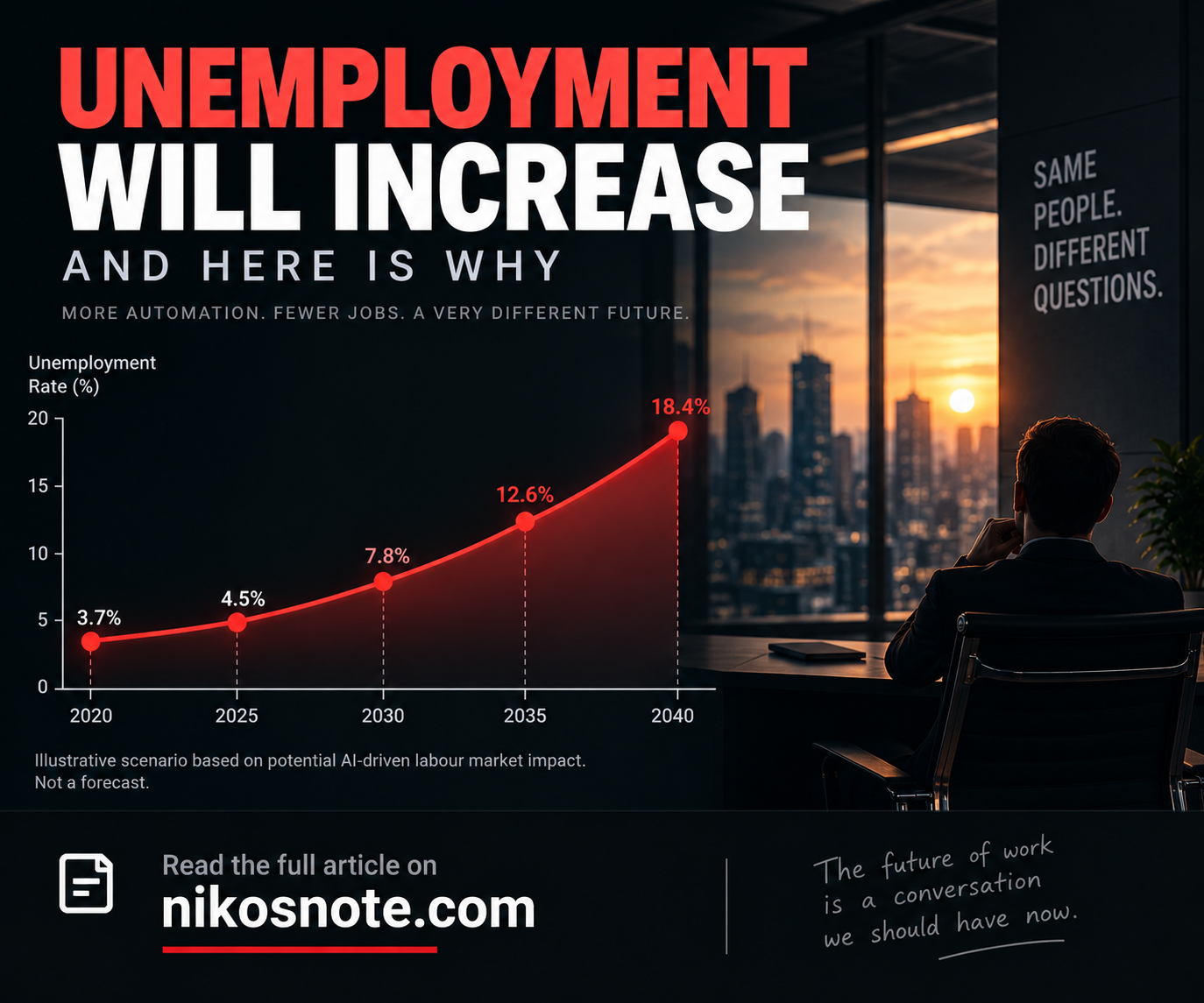
It is clear that, on a weekly basis, we see these new frontier models being dropped. Last week, Fable 5.1 and ChatGPT Astra 6 were dropped.
I played around with Astra 6. Unfortunately, I could not play with Fable 5.1 because Anthropic doesn’t include it in my Pro plan. I am spending nearly €600 a year on my AI subscriptions, so I don’t feel like upgrading it.
As I test more and more new frontier models, there is a recurring thought in my head: what can’t they really do better than humans?
Also, 95% of software developers I meet nowadays say that they have not written any code for the past year. Same if you work in finance. Claude is really good at building a DCF model. In design, those models have also become very good.
Don’t even get me started on research and consulting. It won’t just consult you, it will help you throughout the whole implementation process.
I think all of us should have asked that question already: Is my function becoming obsolete?
Like with everything, let’s go back to history to guesstimate where we are heading. Most likely, it is high unemployment numbers or more of the Elon Musk-promoted world of optional employment.
Early Human Civilization
If you go back in time, during the farming and gathering period, essentially there was no unemployment in society. Everybody worked: men, women, and old people. People died, on average, much earlier, so “old” was not that old in most cases back then.
Kids, after they turned 7 or 8, already started helping their parents, so labour participation was really high. The only people who did not work were sick and really old people. Communities were kind enough to share their food with those people as well.
Urbanization and the Industrial Revolution
The invention of the steam engine and the Industrial Revolution allowed humans to automate a lot of things that required physical power.
Transportation of goods became much easier, tractors came, production lines were created, and mass production was achieved. A good part of physical activity was eliminated in the long term because machines started to do things for us.
If you take the example of modern tractors, a single tractor can replace the work of many farmers.
So we realized that we could create these systems that could free us from this really demanding labour, but now we needed people who were able to design these sophisticated machines and build them: engineers.
The human brain started to gain more traction. If, back in time, the strongest guy was the most desirable on the job market, now strength was replaced by the brain.
If you take a modern tractor, for example, building it requires hundreds of total human labour hours when you account for manufacturing and assembly. Its lifetime can reach thousands of working hours.
We invest a relatively small number of human hours to create a tractor that can then perform an enormous amount of agricultural work for decades.
It does not take a genius to see that all farmers, even if they really wanted to become engineers or tractor builders, simply could not, because we did not need that many people.
Change in Labour Participation
Even though the Industrial Revolution created new types of jobs, it still was not able to fill all those hours of efficiency gains. People eventually started to participate in the human labour market less.
We developed public pension systems that allowed older people to exit the labour market. Child labour laws were adopted, so the labour participation rate of people under 18 significantly dropped.
Women and men also participate in the labour market at different rates. Globally, less than half of women aged 15 and older participate in the labour force, compared with roughly three-quarters of men.
We also had actual unemployment emerge as a measurable economic phenomenon, meaning there were people who wanted to work but were unable to find something to do in society.
Computers Came
We automated our physical labour, and of course, the next thing we went after was intelligence.
Firstly, we were like: it sucks that I have to remember such a big amount of information and have to go back and search in books. Let’s create a system where we can store all of this and just look it up in no time.
We came up with computers.
Then, naturally, we had so much information stored that we started to create systems with logic that would connect different information to each other. We also realized that computers had logic and started to implement simple logical operations.
Everything started to get much larger: systems, transactions, and organizations. We had a bunch of new professions created: auditors, consultants, financial analysts, mukbangers, gamers, dog walkers.
So computers, in a nutshell, also displaced many workers while creating completely new types of work.
A lot of jobs that were created lacked vitality .You can probably take 10 to 20% of the workforce who are not doing a vital job. It does not mean those jobs are useless, but imagine the face of a farmer from the 4th century. He has finished his heavy labour day, he gets back home, and you are there with your laptop showing him BeardMeatsFood’s latest mukbang and telling him that this guy makes 1,000 times more than him just because he sits down and records himself eating.
No hate for BeardMeatsFood. I love his videos.
But still, if he stopped eating in front of the camera tomorrow, I have a good feeling that we would survive as a society.
I’m not going to go through all the professions, but you get the point about some modern professions.
AI
Now we have this huge amount of information stored and systems developed. The next step is, of course, that we don’t even want to operate them or make sense of them ourselves.
Let’s create some kind of intelligence that would make sense of that information, try to develop it, and suggest logical next steps.
We are already there.
These models are really good at doing such things. We will shortly see another effect on the labour market.
If you take the USA, EU, and most developed countries, a huge part of employment consists of jobs where people spend most of their working day sitting in front of computers. Many of those jobs will be able to be replaced or heavily automated by AI.
Probably half of them could already be replaced if you had the systems and structure rightly set up in your company.
BTW, it does not mean professions will disappear. It will just require fewer people to produce the same output we are currently producing.
Farmers never disappeared. We still have farmers. It is just that one farmer with a tractor can now do the work that once required many farmers.
Something similar will happen in the current workforce.
What Is Next?
Okay, we have made human strength less important, and we will very soon make human intelligence less important as well.
One problem here is that these two things are separate for now, and the natural next step is merging the two: the robotics evolution.
In the long run, if we go on with the current trajectory, humanity’s role in sustaining, growing, and creating will substantially decrease.
We just have to make sure humans don’t become obsolete and robots don’t become better humans.
Evil robots won’t be a problem. If evil robots start to arise, it will make us humans much stronger and more united to fight against them, and we will defeat them since we are the creators.
The existential crisis for human beings will come if these robots are universally higher moral beings that we can’t ever be because morality in us is programmed on the basis of freedom of choice.
Humans have this large scale with much more variable morality that allows you to be either Mother Teresa or Adolf Hitler.
Robots won’t have that if we just program them to be Mother Teresa.
A huge existential crisis starts if they become superior beings.
Okay, too much philosophy here. Let’s move on to future professions and how we solve the unemployment issue.
Future of Professions
I hear so many people saying, “Oh, you have better chances now to just go to trade school and maybe become a carpenter, plumber, or technician than going to university to get a job in the AI age.”
Absolutely stupid advice.
If there were so much demand in the market for plumbers, we would have these massive salary increases for plumbers, which we don’t see. And if you flood the market with 20% new supply of labour, congratulations, you just made all the plumbers poorer.
Smart people will be even more valuable.
Even if major breakthroughs happen with AI, people have to guide them, make sense of them, and test them.
If AI suggests this amazing cure, or maybe it suggests inventing batteries that are 90% more efficient and that you need to charge once a year, there should be people who can validate and understand these results, test the safety of them, suggest deployment, budget for them, etc.
It is not going to be that tomorrow AI invents a pill and the day after tomorrow we start using it.
It’s intelligence, but it’s not God.
It will suggest things to us based on the knowledge about the world we have acquired as humans through the years.
People who make sense of these results are going to be very smart people. Most likely, bachelor’s degrees will lose a lot of value. Master’s degrees or PhDs will be required to enter those so-called desk positions that need to be filled.
You don’t have to call it a master’s or PhD. I mean extensive research and understanding of a topic that allows someone to understand the output and implement the ideas of the LLMs.
But the number of people with desk jobs will still be a lot lower than today.
We just have to get used to the fact that more people will exit the labour market.
Government Involvement
Pension age needs to be dramatically decreased, and people in education should be paid.
If you decrease the pension age to 50 years old and young people start to enter the labour market at 25, you naturally cut the number of years people spend in the labour market dramatically.
By 25, young people should be able to achieve PhD-level education and be involved in research. The government should pay for education. Students should be paid to go to university
With that, you naturally create this universal basic income for young people without turning them into goldfish and TikTok dancers.
They know that if they study something extensively and invest time, they will be paid.
If you decrease the pension age to 50, you allow households to have earned enough money for themselves plus pension. Also, by 50, most households should have fewer dependents, meaning kids should be out of the house studying and sustaining themselves.
Pensions have to be comfortable enough that a one-person household lives comfortably. A two-person household should count as a high-income household.
By doing this, people still have a purpose to work towards something and enjoy their time, and the workforce is not overcrowded. Most importantly, young people don’t degrade.
Furthermore, this structure ensures that everyone, at various stages of their lives, gets a chance to contribute to the workforce. I find it quite concerning when only specific demographics are involved in shaping our society, while others are essentially locked out from ever having the opportunity to participate.
The biggest problem we have now that won’t allow us to implement my genius plan is low birth rates.
Actually, the biggest existential problem for Western humanity is low birth rates.
With current birth rates, if we decrease the span of labour market participation, for example, two parents exit the market at 50 and only one kid enters the market, or in some cases they decide not to have a kid at all, maybe the cat or dog decides to enter the market.
You will have very slow rates of labour-force replacement, which will make the substitution very difficult.
I just realized I could easily spend days expanding on this topic, but I think this is enough for now. I am very curious to hear your thoughts on where we are heading. Feel free to reach out via email or connect with me on LinkedIn.