The Hidden Cost of Leverage
How hedge fund almost went bankrupt in hours
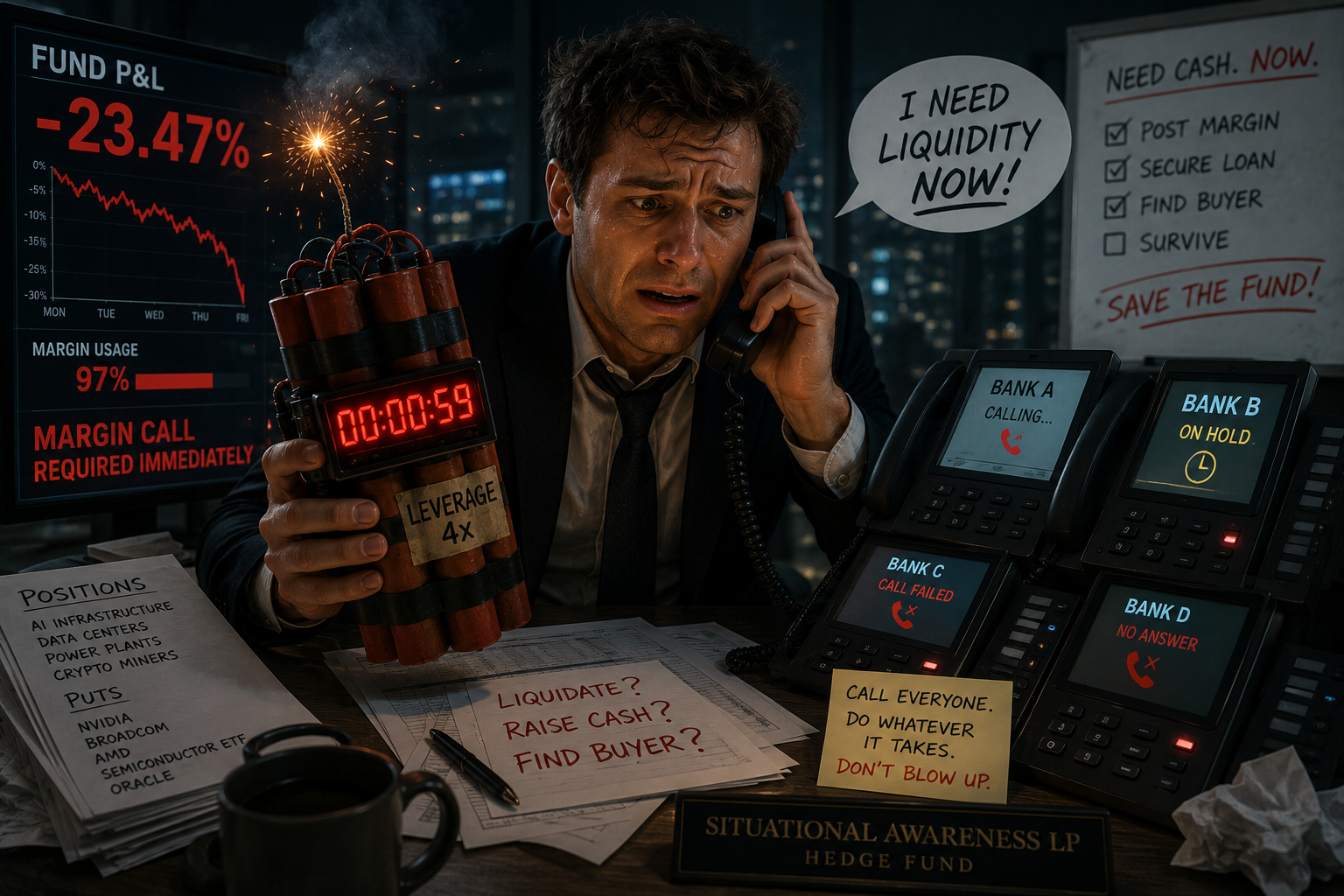
📉Last week, Situational Awareness LP was forced to sell most of its public equity portfolio to Citadel after suffering heavy losses caused by overleveraging.
Let me give some background first. What is Situational Awareness LP?
One of the former OpenAI employees, Leopold Aschenbrenner, wrote a 165-page essay called Situational Awareness about the future scaling of AI. Not to get too much into detail, his hypothesis was that, based on the trends he saw from 2019 GPT-2 to 2023 GPT-3, where intelligence went from preschool-level intelligence to a smart high schooler, if we multiply compute by another 4 OOMs (orders of magnitude), which is a fancy way of saying multiplying by 10 four times, we could reach PhD-level intelligence by around 2027.
According to his thesis, these massive gains are supposed to come from hardware advancements, making algorithms more efficient, and really focusing on post-training. At the end, he concludes that the center of attention will be around data centers, power infrastructure, semiconductor memory, and specialized hardware providers. Those sectors would benefit the most from this kind of growth. On the other hand, he argued that legacy software and application-layer software companies could become structurally disadvantaged if AI capabilities continue to improve at that pace.
After that, he founded his own hedge fund, raised hundreds of millions from well-known investors, and literally started testing his hypothesis. He bought put options on major semiconductor producers, tech equipment providers, and semiconductor ETFs. At the same time, he bought call options and directly held stocks concentrated in energy generation, compute hosting, and crypto miners repurposing power capacity.
Just to clarify the above, once you buy put options or call options, you are not actually buying the asset. You are buying the right to buy or sell the asset at a predetermined price before or at expiration, depending on the contract.
One interesting fact is that, besides the public portfolio, he also used the fund’s money to buy pretty large private stakes in Anthropic and MatX, an AI chip startup.
At its peak, the fund reportedly managed more than $40 billion in assets. (Not sure about validity of this number) It experienced extraordinary performance, reportedly gaining roughly 400 to 450% during the first half of 2026. This kind of growth is basically impossible to sustain in the hedge fund world. On average, most hedge funds barely beat the 10% annual return mark. Even if you look at the very best hedge funds, you’re talking about something like Citadel at an estimated 20% or Medallion in the high 30% range. I’m talking about consistent returns over a long period of time. Every hedge fund can get lucky for one or two years.
📈So, when you hear numbers like 400% or 500%, some alarm bells should start ringing in your head. It does not take a genius to figure out that some kind of leverage was used to achieve those returns.
What is leverage? A quick explanation.
Instead of buying a stock directly, you can buy swaps (TRS, Total Return Swaps). I can go to a bank and say, for example, “I will give you $100 million, and you can give me economic exposure to $400 million worth of stock. I will bear all the economic outcomes.” If the stock goes up, I receive gains based on the full $400 million exposure. If it falls, I also bear the losses based on that amount.
💣This is called 4x leverage, meaning every time my portfolio rises by 1%, it actually gains 4%. But leverage works both ways. If my portfolio drops by 1%, the actual impact on my portfolio becomes 4% because of the borrowed exposure.
In this case, if the stock has a massive correction and suddenly drops by 25%, my entire equity could be wiped out, and the bank would most likely liquidate my position. With swaps, you do not actually own the underlying assets. They remain on the bank’s balance sheet, and the bank can unwind the position if necessary.
Basically, that is what happened last week. Situational Awareness LP held multiple leveraged positions, reportedly up to around 4x, in small and medium-sized AI infrastructure companies. There was a massive correction in some of those positions. The large companies on which they held put options did not experience a large enough decline to offset the losses elsewhere. Banks started making margin calls, asking the fund to provide additional cash to cover those losses.
Keep in mind that if you have 4x leverage, once your portfolio is down around 25%, you are likely to face margin calls. Either the bank liquidates your positions or you have to immediately bring in more cash to cover the losses.
In the end, Citadel agreed to purchase most of the fund’s public equity portfolio, reportedly worth around $16 billion. The fund did not go bankrupt because it still owns its private investments in Anthropic and several other companies. However, the story of those miracle public market returns has now come to an end.
My two cents on leverage trading in general. Oh man, it is so tempting, especially when you are young, to use too much leverage. It is even more tempting when you are getting lucky and your portfolio is moving in the right direction. Your portfolio grows incredibly fast, and you do not need that much money upfront. The temptation is definitely there.
I have tried CFD trading myself. Some brokers allow up to 20x leverage. You can literally see your account double after just a 5% move.
It is extremely risky to hold leveraged positions over the long term. But even in the short term, you never know what might cause a sudden sell-off or correction, how deep that correction will be, or when it will happen. With leverage, you have very little time to save your portfolio. There is often not much you can do. And even if you manage to survive those losses, getting back to your previous peak later is almost impossible.