Is buying a home the right investment right now? 🏠
"Buy it or rent it that is the question" Niko Shakespeare
One of the questions I’ve been asking myself since becoming financially independent is whether I should continue renting an apartment or buy one.
There are two problems with this question. With any other investment I make, I’m usually not emotionally attached to it. But the place you live in is a very emotional asset. It becomes home. You give it your character, and eventually, it almost becomes part of you. That’s why it’s so hard to let it go.
So I have two answers to this question. First, does it make financial sense to buy right now? And second, does it make personal and emotional sense?
The financial answer:
I will again have to go back to history, and I’ll use Hamburg as an example since I live here.
First of all, we Gen Z are already playing a losing game, unfortunately.
I grew up in a house in Tbilisi, Georgia. As a kid, I barely ever lived in an apartment. The house I grew up in was centrally located in Tbilisi. My parents bought it back in 2006 for $20,000 and renovated it with an additional investment of $150,000.
I’m talking about a house with its own garden, centrally located in the capital. With $170,000, you probably couldn’t even build that house in a remote village in Georgia anymore.
In that regard, we are already playing an unfair game. But let’s see how home prices have developed over time and whether we can keep up with them.
I’m currently 27 years old, so I usually take my dad’s age and compare the standard of living back then.
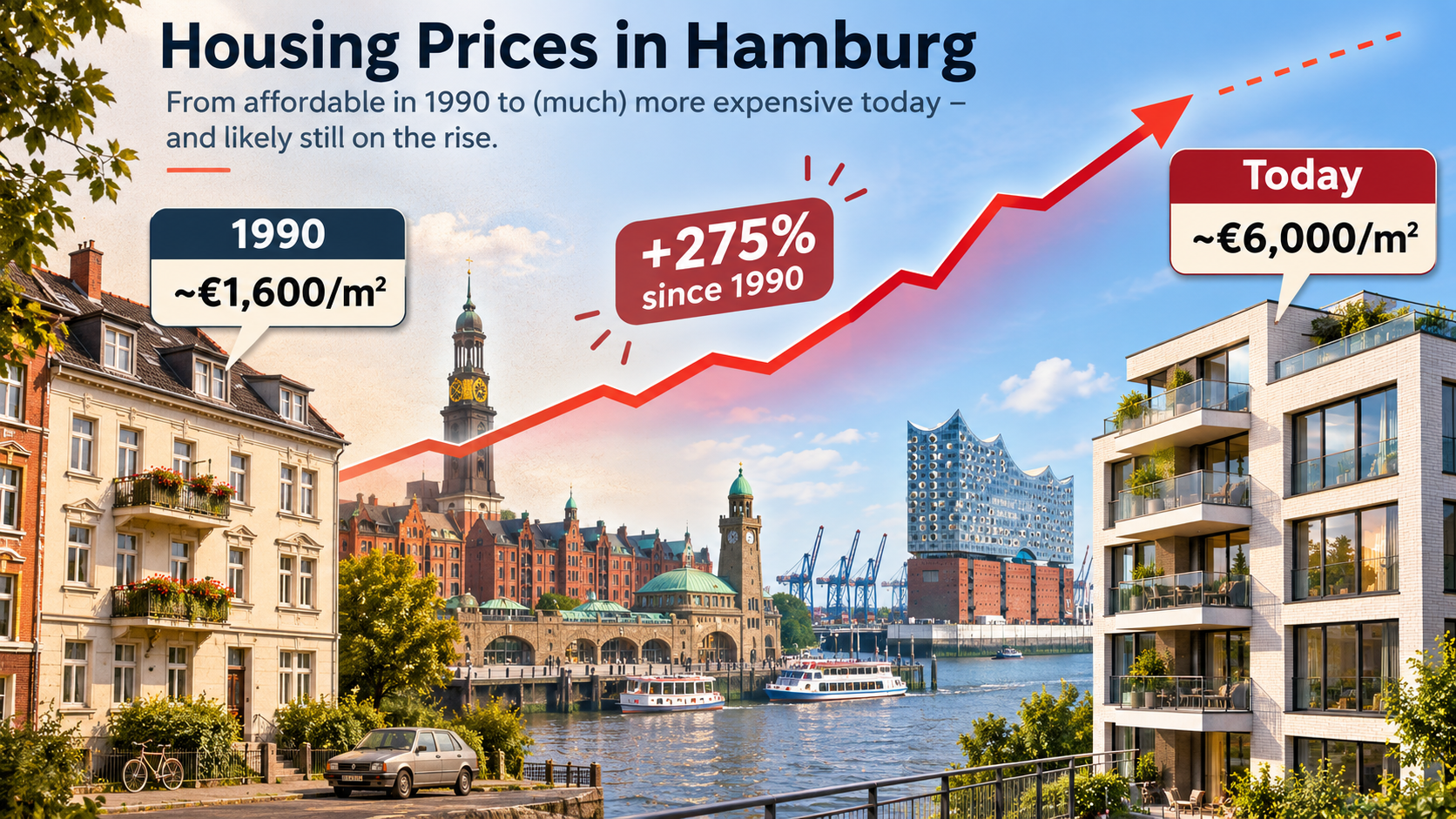
My father was 27 back in 1990. If he had lived in Hamburg like I do and decided to look for an apartment, not in the city center or some posh residential area, he might have found something for around €1,600 per square meter.
If he had studied finance like me, completed a master’s degree, and started his first job, let’s assume he would have made around €1,500 net per month.
These are estimates, of course. I’ve also converted Deutsche Marks to euros approximately.
Let’s look at today’s prices in Hamburg.
If you’re looking for an apartment, you’re looking at approximately €6,000 per square meter on average. And if you’re a recent graduate with a master’s degree in finance, your net salary might range between €2,600 and €3,000.
Let’s take the high estimate of €3,000.
So basically, apartments have become 3.75 times more expensive, while salaries have only doubled.
This is what I mean when I say we’re playing a losing game.
Based on these rough numbers, housing prices have appreciated by around 3.8% annually since 1990. If you adjust for inflation, the real increase is considerably smaller.
If you had put that money into the stock market instead, you might have achieved around 7% annual returns over the long term.
But you also have to account for the money spent on rent, right?
You have to measure that extra return against the non-recoverable money you pay in rent.
Plus, when you own a house, there’s probably a need for renovations after 30 years.
If you sell a home after more than 10 years of ownership, or if it qualifies under the primary-residence exemption, you generally don’t pay capital gains tax in Germany.
Unlike in the stock market, where you usually pay 25% capital gains tax, plus applicable surcharges.
But at the same time, you have to pay mortgage interest. Current rates are around 4% or higher, depending on the financing.
And that’s before accounting for purchase costs, maintenance, and other expenses.
When you add it all up, I think my father would still have made a pretty solid investment.
He would have avoided paying rent for decades, paid off his home by retirement, and potentially invested in the stock market as well.
But what about now?
Firstly, I have one pretty clear opinion. If you’re looking to purchase a second home purely as an investment and take out a mortgage on it, I would be very cautious.
Especially when you account for all the liabilities, interest, maintenance, and taxes. It might take many years to get a decent return on your investment. Personally, I would rather stick with capital markets.
But if you’re purchasing your first home, where you’re actually going to live, my answer is yes. And if you’re buying outside Hamburg, even better.
Hamburg is a very unique city.
Even when the older homeowners pass away and their properties eventually become available for sale, there will still be significant demand for housing.
With the current pace of construction and old infrastructure, demand in Hamburg is so high that I personally don’t expect any major house price drops over the next 15 years.
In 2025, Hamburg had net immigration of around 8,500 people, while only 5,976 new apartments were completed.
There is a very slow buildout.
Housing in Hamburg is going to remain scarce unless the city starts building at a much larger scale, significantly increases housing density, and develops a lot of new S-Bahn and U-Bahn lines for connectivity. I don’t see that happening quickly.
So if you’ve decided to buy something in Hamburg, I don’t think prices will get dramatically better anytime soon. You might as well start looking now. Also prices for renting are not getting better as well
If you don’t care where you buy, there are a lot more affordable cities in Germany.
The other day, I was reading about Leipzig. It’s a growing city, and apartment prices are less than half of what you would pay in Hamburg in many cases.
Is it the most exciting place to live in Germany? Probably not. But from an investment perspective, you might be able to sleep better at night.
The emotional answer: ❤️
I think you should buy an apartment where you actually want to live, in a place where you feel most comfortable, even if that means settling for fewer square meters.
In big cities, not just Hamburg, I don’t expect to see massive drops in housing prices in the long run. Space is scarce, and there’s only so much you can build without expanding toward the outskirts.
The only time I would say not to buy anything is when you have extremely low rent.
I’ve met people in Hamburg who pay €600 in rent.
If they bought something similar, their mortgage payment could easily be triple that amount. And on top of that, they would still have to pay maintenance, building service fees, insurance, and utilities.
In that case, I would say stay where you are.
But if you’re already paying a pretty high amount in rent, buying starts to make more sense.
At the end of the day, I think buying a home is one of those rare decisions where the financially optimal answer might not be the right answer for your life.