I Read Anthropic's S-1 Filing So You Don't Have To
Its a girl with massive red flags but good looks

Two weeks ago, I was flying to Bucharest over the weekend. It was a long-planned trip, and the flight was around 3 hours. I took a Wizz Air flight, a cheap airline, so there is basically no entertainment system, no internet for over 3 hours, and it is complete boredom.
So, on the way to Bucharest, I finished reading American Sniper, one book that gave me absolutely no inspiration. It’s completely mental. Human lives treated as numbers, the absolute mental distortion soldiers go through during wartime. Very challenging book.
So, on the way back, I saved the recently published S-1 filing from Anthropic on my tablet and read it.
I actually did not read the whole S-1 filing. It’s 300 pages, I am not that crazy, but I skimmed through it and noted the important points.
First of All, What Is an S-1 Filing?
There are actually a bunch of S filings, not just S-1 filings, but when a company files an S-1, it is an official registration with the SEC (Securities and Exchange Commission) that the company is trying to go public.
An S-1 filing consists of everything: all the current financials, background of the company, addressable market, risks. It’s a massive document.
So, Anthropic submitted it a couple of weeks ago, and the SEC made it public for us to read.
Let’s Start With the Numbers
There are some alarming numbers that were already reported.
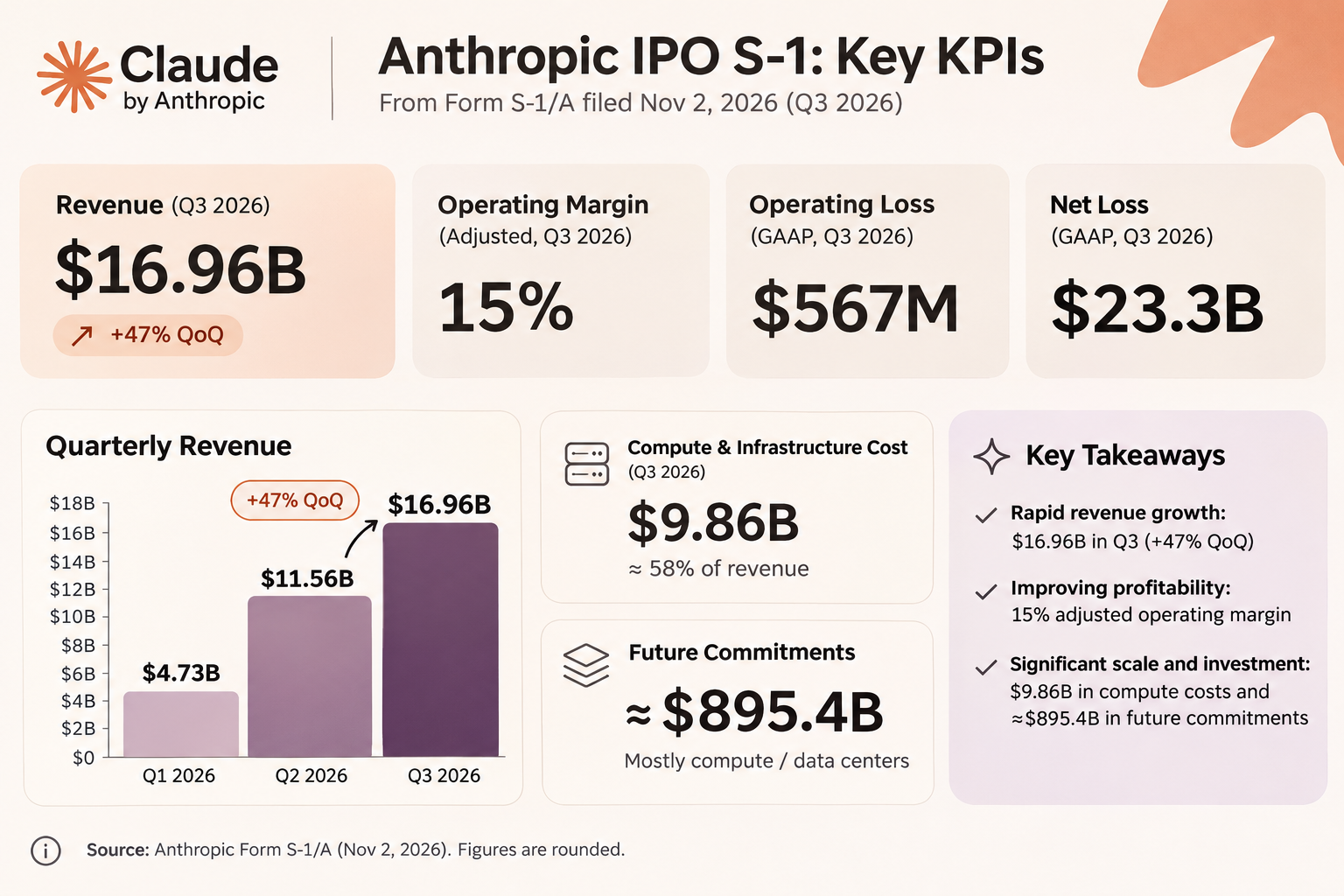
They signed $895 billion in future commitments, with around $70 billion due in the next 12 months. They reported a net loss of around $23 billion. These numbers we all expected more or less.
Some positives as well. In the first six months, they reported around $17 billion in revenue, and they hold over $100 billion in cash and cash-equivalent assets, including short-term investments.
Any company that goes from $0 to $32 billion in revenue in 3 years is just very impressive. But the question is, is it sustainable?
Before I answer this question, I want to talk about a couple of things I found interesting in the S-1 filing that most people don’t talk about.
1. Anthropic Has Five Different Classes of Shares
Anthropic has 5 different classes of shares, which I have never seen before.
Offering different classes of shares is not uncommon. Many companies do it when they go public.
For example, Mark Zuckerberg owns around 13% of Meta, but he has around 61% of the voting power.
What does it mean?
At some point, Meta divided the company into 2 classes of shares, Class A and Class B. Class A shareholders only get 1 vote per share in the company, but Class B shares get 10 votes per share.
Mark’s shares are mostly Class B shares. Even though Mark only owns around 13% of Facebook, he holds an absolute majority in decision-making.
In Anthropic’s case, there are 5 different classes. To explain all 5 would take me a whole research-paper-sized explanation, but I found one interesting fact.
Class F shares are called founders’ shares, which carry 50.1% of the voting power in total.
There are 7 founders, so a huge part of decision-making lies with the founders. Two of the founders are Dario, the CEO, and his sister Daniela.
In the filing, we read that if fewer than 3 founders are left, let’s say Dario and his sister piss off everyone and they decide to leave, a 450-day wind-down period starts after the required 90-day period. At the end of that period, Class F shares lose their 50.1% voting power unless they find replacements
If Dario and his sister try to act in a way that is not supported by the company and everybody starts to boycott them, they could eventually lose their control.
I have never seen this setup before. Very unique.
Anthropic also has the Long-Term Benefit Trust, which I wrote about in a previous blog. You can read it here.
2. Anthropic’s Debt Is Very Interesting
Another interesting fact I saw is their debt.
Besides the massive investments Amazon and Google have in Anthropic, they also provided them with potential debt financing.
But it’s a weird option.
They have so much ownership of the company that Google or Amazon would never want Anthropic to go bankrupt because they would just wipe out hundreds of billions of dollars in potential value for themselves.
But there is another interesting lender.
Broadcom also provided a potential financing arrangement worth up to $42 billion.
The financing has a 9% interest rate, which can increase to 13% if certain revenue conditions are not met. There is also an option where the debt can be converted into shares at a discounted valuation under certain conditions.
It means if Anthropic is under the gun, the IPO tanks, and they have to exercise Broadcom’s financing option but can’t really perform at a high level, Broadcom could also suddenly become a heavy player.
3. How Much Can Anthropic Actually Raise From the IPO?
The last thing I wanna talk about is the float.
The float they offer is not known yet, but I am assuming a 5% offering for this example.
If they float at 5%, and supposedly, from the numbers I read, they aim at a $1.2 trillion valuation, the maximum they can raise from selling that 5% would be $60 billion, assuming all those shares are newly issued by the company.
Maybe they can raise additional capital through debt as well by issuing bonds.
But around $70 billion is already committed over the next 12 months through future obligations they must fulfill. 60 billion does not look that massive
Overall, What Do I Think About Anthropic’s IPO?
I mean, we kind of all expected these numbers.
One thing I was actually surprised by was over $100 billion in cash reserves and short-term investments for a company that inherently loses money.
Apparently, a large portion of the money they have raised from investors has not really been spent and has been kept in cash and investments.
As a finance guy, this is not the financially healthy company you invest in. They have red flags over red flags, but this is more of a bet you are willing to take.
They have very healthy growth, but with the current model of just token selling, I think they will definitely hit a wall and fail.
The bet you, as an investor, are willing to take is that they manage to capture some value other than token selling.
Which is a big unknown right now. That’s why I call it a bet.
They need to actually expand their offering of services more into medical, finance, logistics, which is massive, and robotics.
But other companies, such as SpaceX, Google, Meta, and Amazon, have much, much stronger foundations in different industries, so it will be very hard to compete.
I really like Claude. I think Opus 5.5 is currently the best model on the market for coding, and most likely they will release something magnificent before the IPO to hype up the price, and it will be even better.
I love their product, but the math does not add up for me, so I won’t be participating in the upcoming share purchasing.
Especially at a $1.2 trillion valuation.