Are We in an AI Bubble?
We are in the bubble but no need to panic
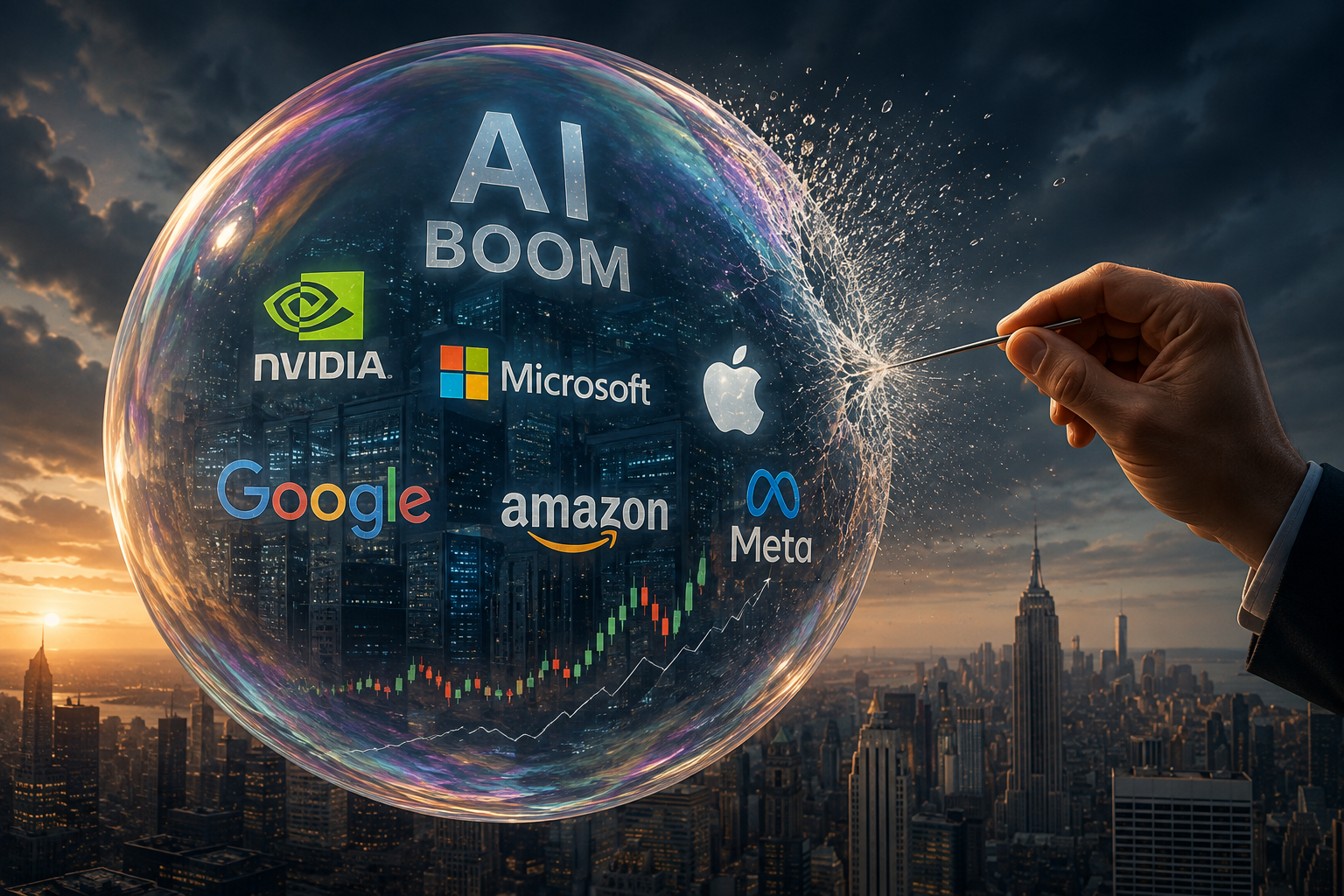
What is a bubble, firstly? I mean a financial bubble here.
The way I define a financial bubble is when there is much more expectation of short-term returns than the true outcome can justify.
According to my definition, currently we are in an AI bubble that will correct at some point.
But it is not really about AI. When there is hype around a topic, every time it bloats up, people want to jump on the train early. Then you have too many people jumping on the train, and that creates these enormous valuations.
It is also not unusual.
We had the dot-com bubble in the 2000s, when everybody started tech companies. And it was clear, right? Tech would become a huge part of our economy. People were not wrong about the technology, but the bubble still burst. The market eventually came back.
Actually, what a lot of people don’t know is that one of the earliest and most famous examples of a speculative bubble was the tulip mania in the Netherlands in the 1630s.
Tulips became this really hot commodity. Some rare tulip contracts reached extraordinary prices, with historical accounts comparing certain prices to the value of houses. Then demand disappeared and prices collapsed.
The interesting part is that historians still debate how extreme the tulip bubble actually was. The popular version of the story, where basically the entire Dutch economy went crazy buying tulips and then collapsed, is probably exaggerated.
Tulips obviously never recovered as a speculative asset.
This Time We Have a Slightly Different Bubble
Let’s just look at the USA.
If you measure the top 500 companies through the S&P 500, you have around $70 trillion worth of market capitalization. Roughly a third of that is concentrated in only a handful of companies, mostly technology companies heavily invested in AI and its infrastructure.
Since late 2022, around the time ChatGPT was released, the S&P 500 has more than doubled.
This is not normal, by the way. We are seeing levels of market concentration and valuations that are historically very high.
So what are the characteristics that would tell us that this is probably a bubble?
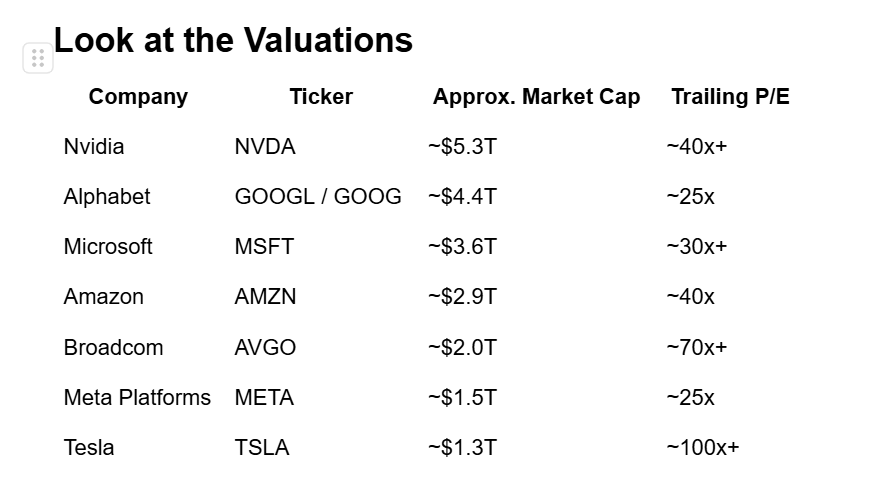
If you take just trailing P/E, the historical long-term average has been somewhere around the mid-teens, although the exact number depends on the period you measure.
What does P/E actually mean?
If a stock trades at $100 and has $6.67 of earnings per share, its P/E would be around 15x. Basically, investors are paying $15 for every $1 of annual earnings the company currently generates.
If you look at Tesla, for example, when it trades above 100x earnings, investors are paying more than $100 for every $1 of annual earnings.
That does not automatically mean Tesla is worth too much. It means the market is pricing in enormous future growth.
And that is exactly where the bubble question becomes interesting.
Long Term, These Valuations Might Look Like a Joke
BTW, if we talk about the long-term valuation of these companies and judge it in a 50 to 60-year timeframe, these numbers are going to look like a joke.
The amount of value AI could create in the end could be measured in quadrillions with today’s money.
We are talking about superior intelligence that can potentially be deployed instantly on machines, computers, robots, etc.
The reason I think we are going to have a big correction in between is that adoption of the technology will lag quite a bit.
These massive economic gains from AI will take substantial time because companies, governments, and humans in general need to adapt to living and working with these systems.
One correction that we could have is CAPEX delays.
We have these massive CAPEX plans from all the companies building AI infrastructure, but not all projects will be completed on time. Some will be delayed, and some might not be completed at all.
Why I Think We Will Have a Correction, Not a Complete Collapse
All of the companies above operate in businesses that have really high barriers to entry.
You will barely see competition there.
Do you know how much it takes to start a new Nvidia, Google, or Amazon?
It is probably easier to start building cargo ships than to compete with Nvidia.
Even with LLMs, because of the computing power required to train and run the largest models, you could see fewer and fewer new companies tackling the LLM problem because the startup cost is already really high.
So the playing field is already starting to look like it will remain concentrated around these companies.
Can the Bubble Burst?
Yes.
There are multiple reasons it can burst.
One is China.
If China masters frontier chip manufacturing at scale and drops the prices of chips like it did with solar panels, the economics of today’s AI infrastructure could change dramatically.
Another possibility is a massive breakthrough in quantum computing, or LLMs simply becoming really efficient.
Imagine that the world’s best model can suddenly run from your phone.
What happens to the hundreds of billions being invested in data centers?
That could cause a major correction as well.
Another possibility is governments declaring AI strategic infrastructure and states getting heavily involved in its development. You would suddenly have completely new sources of capital and completely different economics around AI infrastructure.
But if we see breakthroughs big enough to completely destroy today’s AI infrastructure valuations, I don’t think anyone should be worried about stock valuations by that point.
Because money itself might matter much less.
You would have abundance of intelligence and strength available at all times.
And that is the weird thing about this bubble.
I think AI stocks can be massively overvalued in the short term while AI itself is massively undervalued in the long term.
Both things can be true at the same time.