According to economics, you might feel less "miserable" in Niger than in the US.
Misery is relative
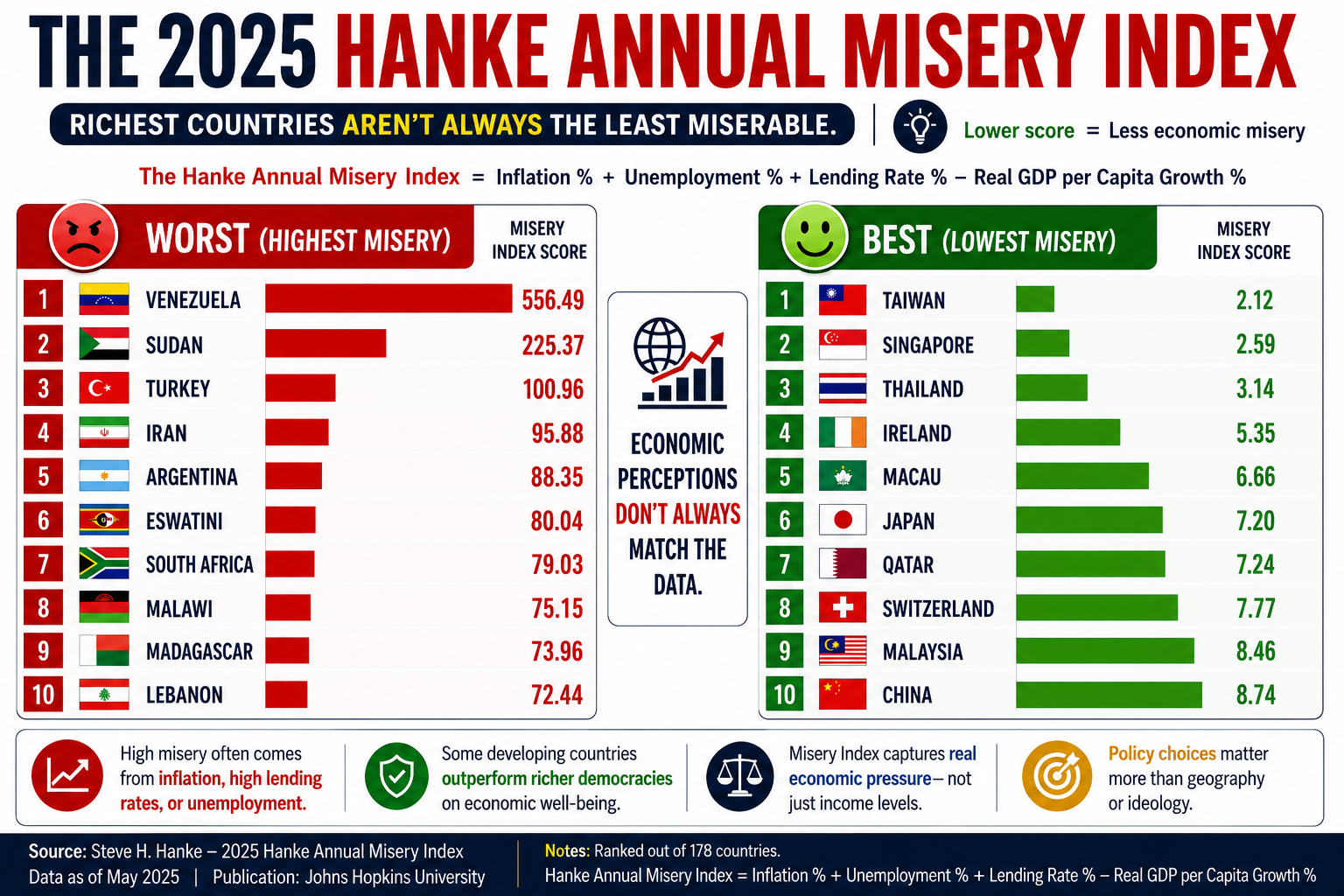
One economic measurement we don’t hear about often, but which may become more relevant in the near future, is the Misery Index.
Calculating the index is straightforward: it is simply the sum of the unemployment and inflation percentages.
🔄 The Phillips Curve & The 1970s Crisis
To provide a quick recap: if you study economics, one of the first graphs you encounter after the supply and demand curve is the Phillips Curve. 📊
- The Concept: The Phillips Curve shows a negative relationship between unemployment and inflation, meaning that low unemployment typically leads to higher inflation, and vice versa.
- The Curve: An interesting characteristic is that this relationship is a curve, not a straight line; as you push unemployment toward zero, inflation tends to rise at a significantly higher rate.
- The Logic: When there is a shortage of workers, hiring becomes more expensive due to decreased competition. These higher operating expenses are then passed on to consumers, driving prices up. 📈
Like everything in economics which is not an exact science (don’t tell the fellow economists I said this! 🤫), this logic was challenged during the 1970s crises. The U.S. entered a period of stagflation, where, contrary to the expected negative correlation, both unemployment and inflation rose simultaneously. ⚡
Arthur Okun, an economic advisor to the U.S. President at the time, noticed this and developed an index to measure true economic discomfort. If people are unable to find jobs and food prices are simultaneously rising, they are bound to be miserable. 🛑
Modern Variations: Hanke’s Index
The Misery Index has been modified multiple times. The latest version I came across is Professor Steve Hanke’s modified Misery Index (the Hanke Annual Misery Index), which uses:
HAMI = 2 x Unemployment + Inflation + Bank Lending Rates - Annual % Change in Real GDP per Capita
I believe this provides a better representation of economic hardship. ⚖️
🌍 Looking at the 2025 Numbers
Let’s dive into the interesting part and look at the 2025 numbers:
- The Most Miserable: Venezuela was the most miserable country, which is not surprising as it faced an inflation rate of over 400% in 2025.
- The Least Miserable: Taiwan was the least miserable, remaining relatively stable if we don’t count occasional Chinese fighter jet training in the coastal area.
- Syria: Has recovered slightly after Assad’s departure.
Anomalies: Niger & Mali vs. US & Germany
Some results are logical, but we also see interesting anomalies. According to the index, you are becoming less miserable in Niger and Mali than in the United States or Germany.
At first glance, this seems unbelievable, but further investigation suggests it may not be entirely false. Take Niger: 🇳🇪
- Low Official Unemployment: It has an extremely low unemployment rate of less than 1%. Of course, many people counted as “employed” in Niger are farmers or work in the informal economy, which is not comparable to the labor markets in Germany or the U.S.
- Rural vs. Urban Context: Unemployment in New York is very different from not having a job in an agricultural region of Niger. You cannot simply start planting corn in Central Park 🌽, whereas in Niger, many unemployed individuals rely on harvesting or foraging for their own food.
- Deflation & Growth: Additionally, Niger experienced nearly 8% GDP growth and reported deflation due to over-harvesting, which lowered food prices.
Now, I feel like I am hyping up Niger too much. Let’s bring it back to reality: it remains one of the poorest countries in the world, with a GDP per capita of $800, massive infrastructure problems, and human rights violations. They have been in an active conflict since 2023, so I definitely do not recommend moving there. ⚠️
However, my thought process is different. 💡
🧠 The Psychology: Loss Aversion & Reference Points
One of the books I read years ago was “Thinking, Fast and Slow” by Daniel Kahneman. He introduced the concept of prospect theory, part of which is “loss aversion.”
The basic idea is that people feel the pain of a loss roughly twice as intensely as the happiness of a gain. 📉 > 📈
It depends on the starting point. People in Niger might appear less miserable because their starting point is much lower, and their quality of life is not declining at the same rate as someone living in a developed country who has significantly more comfort to lose. 🛋️