5 Things Renewable Energy Taught Me in 2 Years
We have ducks in solar energy
After almost two years working in the renewable energy sector, there are a few interesting facts and observations I have learned and gathered.
🦆 Observation 1
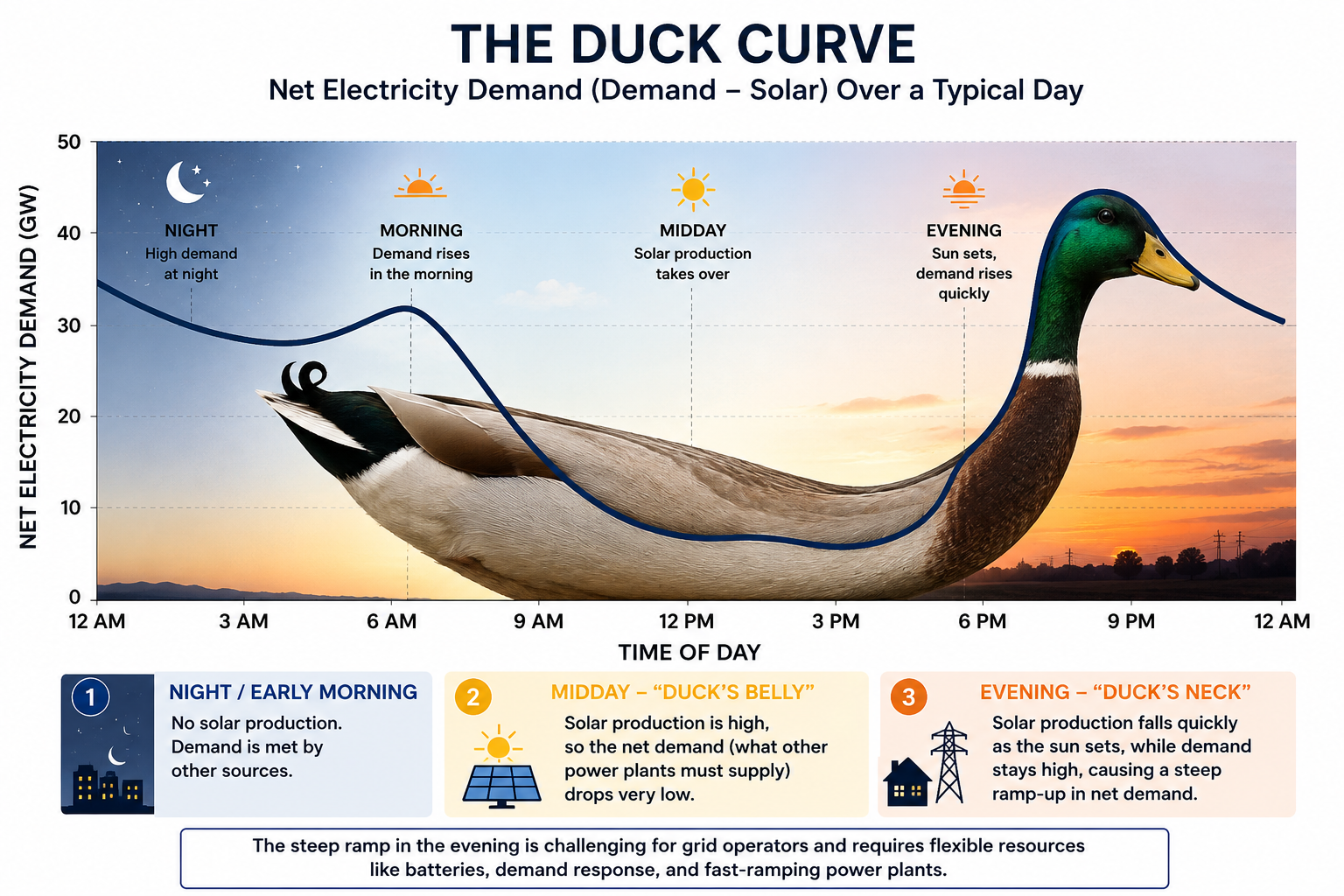
In solar, we have a graph called the duck curve. The duck curve shows how net electricity demand minus solar generation changes throughout the day. In other words, it shows how much energy you need from other sources besides solar.
Why is it called the duck curve? That question might have crossed your mind. It is because the graph literally looks like a duck.
At night, you have high demand for other electricity sources because the sun simply does not shine, so solar energy production is zero. However, the overall electricity demand also drops since people go to sleep and do not use as much electricity.
The first spike appears when people wake up and get ready for work. Net electricity demand starts to rise again, while the sun is just beginning to rise and is not yet in the optimal position to generate the most energy.
During midday, the sun really takes over. Net electricity demand drops because solar is doing most of the heavy lifting.
As people start heading back home and the sun begins to set, you see another spike in net electricity demand. Then it starts to drop again after people go to sleep.
If you take a pencil and draw the graph based on the information I just told you, it should actually look like a duck. That is why we need more energy storage for solar to turn ducks into crocodiles.
☀️ Observation 2
We all love sunny, relaxing weekends, but renewables are not really big fans of them.
The wind does not blow strongly enough, so wind turbines are not able to generate much electricity. Solar is booming and doing its job, but most people are outside enjoying the weather, so we do not really get the financial benefits of selling electricity to customers.
Now imagine a sunny Tuesday that is not too hot, with a little bit of wind until around 6 p.m. Then suddenly the wind gets stronger and it starts to rain. Renewable assets are happiest under those conditions.
🐦 Observation 3
It turns out birds are not stupid enough to be killed by turbines.
For a while, there was a hypothesis that birds would fly into turbines during migration periods. However, recent studies show that birds are smart enough to avoid flying through turbine blades.
🌊 Observation 4
Offshore wind turbines can act as artificial reefs.
They provide hard surfaces where algae, mussels, barnacles, and even corals can grow. This attracts fish and can create entirely new habitats, forming new underwater communities around the turbines.
⚡ Observation 5
Lastly, there is a huge supply and demand imbalance when it comes to transformers.
Sometimes, the waiting time to get a transformer can be measured in years. Suddenly, everyone needs transformers. Huge data centers, aging grids, electrification projects, and new renewable energy developments all require them.
There are not enough manufacturers on the market, and even the biggest players have not been able to ramp up production as quickly as demand has grown.
Transformers step electricity voltage up or down in AC systems. They are essential for transporting electricity efficiently over long distances.
One thing I am really proud of is that, despite the constant pressure and political uneasiness surrounding renewables, there are companies like Vattenfall that have stayed true to their values and kept investing in and building new renewable energy plants.